


What is a Corporate Parent?
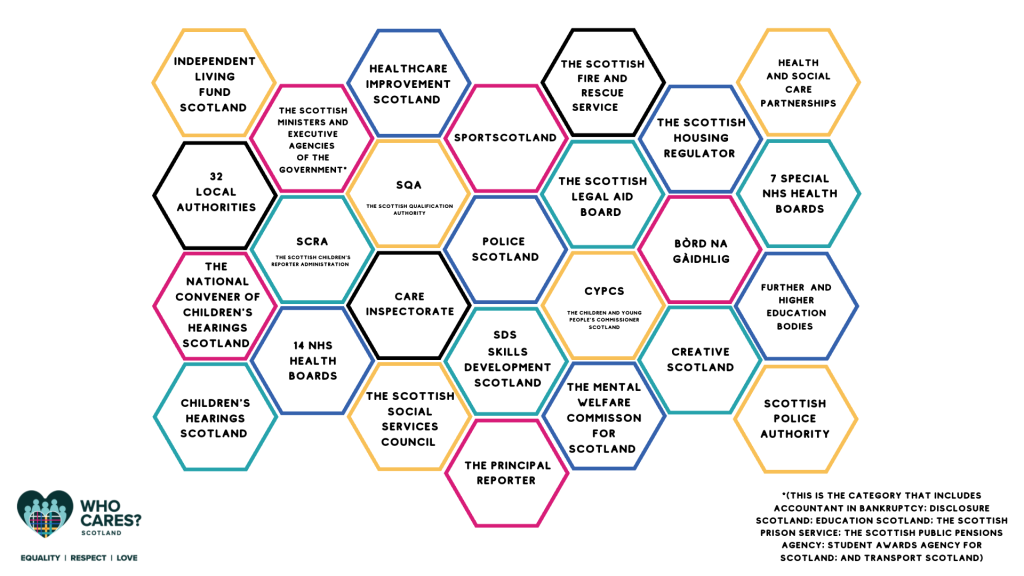
A Corporate Parent is one of the following individuals or bodies which are named in the Children and Young People (Scotland) Act 2014.

Under this legislation, Corporate Parents have specific duties and responsibilities towards Care Experienced children and young people up to the age of 26 (although many Corporate Parents go further and extend their support and policies to Care Experienced adults above the age of 26, which we celebrate and consider best practice).
Although the Children and Young People (Scotland) Act has been enacted since 2015, the idea of Corporate Parenting is not new. The term first appeared in the late 1990s, and the concept of Corporate Parenting has actively informed Scottish Government policy since its 2007 report, ‘Looked After Children and Young People: We Can and Must Do Better’.
When the state takes on a parental role for a child or young person, we all have a part to play in their wellbeing. Corporate Parents have a vital role to play in ensuring the rights of Care Experienced people are upheld, and that they have the best chances and outcomes in life. Corporate Parenting is all about asking – “would this be good enough for my child?” Just as it takes a village to raise a child, it takes a diverse network of Corporate Parents to support the Care Experienced community.
Corporate Parenting Duties
As a Corporate Parent, you have the following duties as set out in the Children and Young People (Scotland) Act 2014:
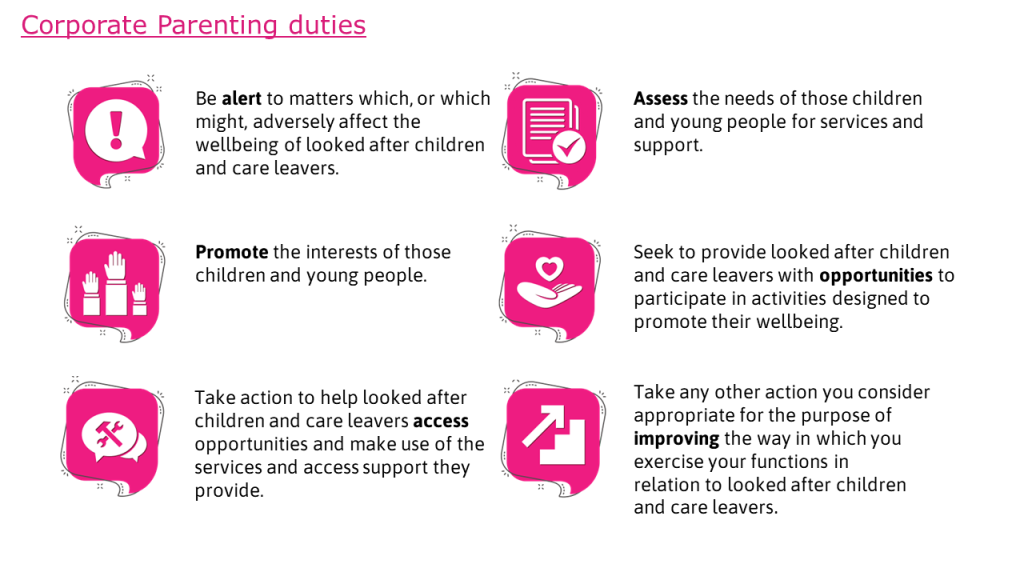
You can find more extensive guidance around these duties and what they mean here.
Corporate Parenting Network
Are you a Proud Corporate Parent? Do you want an opportunity to shout about the work you’re doing for Care Experienced people, while learning what others outside of your own sector are doing?
We’re looking for Corporate Parents who are passionate, driven and excited about Corporate Parenting to connect with other like-minded individuals based not on locality or sector, but a desire to make a difference for the Care Experienced community.
CORPORATE PARENTS TOLD US they wanted more opportunities to collaborate and ways to keep Corporate Parenting on the agenda.
CORPORATE PARENTS WANTED real, tangible examples of positive Corporate Parenting from other organisations which they can learn from/adapt for their own teams.
INTRODUCING The Who Cares? Scotland Collaborative Corporate Parenting Network: a space for Corporate Parenting pioneers to come together and collaborate and share Corporate Parenting plans and ambitions in an informal, exploratory way.
Together we can improve the lives of those with care experience. We look forward to hearing from you!
Contact us by emailing: corporateparenting@whocaresscotland.org
Corporate Parenting Learning Hub
Who Cares? Scotland have created a Resource Library which hosts a number of individual and thematic digital resources. On this page you’ll find the most recent Corporate Parenting resources which can be downloaded and integrated into existing training platforms.
Support for Implementation of Resources
We are more than happy to offer support and guidance on implementing these resources within your own training programme, or to assist in the development of bespoke resources or modules which offer more contextual insight into the function of your organisation and how it relates to young people. If you would like to discuss the possibility of co-developing e-learning resources and/or bespoke materials, please email corporateparenting@whocaresscotland.org
Corporate Parenting Plans: Best Practice – Guidance Document
We have written this new guide to support you when you are creating your new Corporate Parenting plan. The document draws on the statutory guidance issued by Scottish Government for Corporate Parents and offers advice on content, structure and design.

The Corporate Parenting Duties in Universities
In this video, we explore how the statutory Corporate Parenting duties may be upheld by various roles and departments within a university.

Corporate Parenting Newsletter and Promising Practice 2025 – 2026 Issue Three
In the third issue of our 2025 -2026 Newsletters we share some of our newest resources and a recap of our Summer Festival.
Collaborating as Corporate Parents
We have created this guide to help you collaborate and build strong working relationships with other Corporate Parents. The guide explains the duty to collaborate and breaks down the Scottish Government Statutory Guidance. We hope it will help you connect with other Corporate Parents on this exciting journey.
What is Corporate Parenting? – Collaboration
This video explains the duty to collaborate as Corporate Parents. In the video some Corporate Parents discuss the importance of collaboration.
The Scaffold of Support – What could it look like in your organisation?
We have created this interactive guide to help you understand and explore the Scaffold of Support. We have included templates for you to map out what the scaffold within your organisation could look like.

Education and Engagement Support for Corporate Parents – 2025 – 2026
We are delighted to present our offer of Support for Corporate Parents for 2025 – 2026. Please don’t hesitate to get in touch with us if you would like to discuss any of the support available.

Corporate Parenting Newsletter and Promising Practice 2025 – 2026 Issue Two
In the second issue of our 2025 -2026 Newsletters we share some of our newest resources and some amazing offers for Who Cares? Scotland members.
Self-Assessment tool for Corporate Parents
We have designed this tool to assist you and your organisation in your role as a Corporate Parent to evaluate your effectiveness and to enable you to reflect on areas you may wish to strengthen.
This downloadable PDF is interactive so you can complete it and save it for reference.

Corporate Parenting Newsletter and Promising Practice 2025 – 2026 Issue One
In the first issue of our 2025 -2026 Newsletters we share some of our newest resources and a collaboration with Scottish Qualifications Authority.
Corporate Parenting: A guidance document for Finance Departments
Part of a series of guidance documents to support non operational roles within Corporate Parenting organisations to understand their Corporate Parenting duties and how to fulfil these in practice to support the Care Experienced community to thrive. This document is aimed specifically at Finance departments.
Corporate Parenting: A guidance document for Human Resource Departments
Part of a series of guidance documents to support non operational roles within Corporate Parenting organisations to understand their Corporate Parenting duties and how to fulfil these in practice to support the Care Experienced community to thrive. This document is aimed specifically at Human Resource departments.
Want to check out the full Resource Library?
Here you’ll find our full range of resources which can be filtered by type and theme depending on what you are looking for.
Filter by theme ‘Corporate Parenting’ to see all our resources.
Training and support for Corporate Parents
The Education & Engagement Team at Who Cares? Scotland offers fully-funded support to Corporate Parents across Scotland. Find out more about this offer on our Training & Support page.
Our Photos
Take a look at the photo albums from our most recent Corporate Parenting events.
Find out more
Understanding Corporate Parenting in Scotland
Corporate parenting is a statutory responsibility in Scotland, established under the Children and Young People (Scotland) Act 2014.
It requires public bodies and organisations to uphold the rights and wellbeing of Care Experienced children and young people. This duty extends beyond providing services—it encompasses acting with the same commitment and care as any good parent would.
At Who Cares? Scotland, we support corporate parents in fulfilling these obligations by offering training, resources and opportunities for collaboration. Our goal is to ensure that every corporate parent is equipped to make a positive, lasting impact on the lives of Car Experienced individuals.
By embracing the principles of corporate parenting, organisations can contribute to a more inclusive and supportive environment, enabling Care Experienced people to thrive.