


Earlier this year, we published our Connected by Care manifesto, informed by our recent advocacy and participation evidence from the Care Experienced community, our Lifelong Rights campaign and conversations with our members at our Summer Festival in 2025, where they helped shape our priorities.
What emerged were five key asks which have been consistently raised by the Care Experienced community for many years. This response explores whether this Programme for Government addresses these priorities and crucially, whether it will help deliver the change that Care Experienced people have been calling for.
Ensure the Promise is kept in full and fully resourced, with processes to track its delivery up to and beyond 2030.
Scotland is now over halfway through the ten-year plan to implement The Promise. And yet, the most recent Oversight Board report in 2025 found that “some people, some organisations and some systems are not yet doing enough, and this risks the country as a whole failing.”
We all know there is more to do. Whilst it is clear that commitment remains high and some progress is evident, currently, the Promise still risks being broken.
The Programme for Government has recommitted to keeping the Promise by 2030, which we welcome. It also commits to developing an updated implementation strategy this year, setting out the progress made and the key actions the Scottish Government will make next.
With a new parliamentary session, a new Government and a new Minister; there is an opportunity for refreshed leadership and momentum. That momentum must now translate into real, tangible change for Care Experienced people and those working in and around the care ‘system’ across Scotland.
Who Cares? Scotland will continue to be there every step of the way through amplifying the voices of Care Experienced people and ensuring that the commitments made become meaningful action. The next four years are critical and there is no time to lose if Scotland is to keep the Promise by 2030.
Keep Care Experienced people’s voice at the heart of the Promise, implementing the statutory right to independent, relationship-based, lifelong and accessible advocacy for all Care Experienced people who need it.
Earlier this year, the Children (Care, Care Experience and Services Planning) (Scotland) Act was unanimously passed, bringing a raft of important changes including reforming the Children’s Hearings System, extending the eligibility of aftercare and the right to independent, lifelong advocacy.
Our Action on Advocacy campaign called for the right to independent advocacy to be included in this legislation. This built on more than five decades of calls from Care Experienced people to have a meaningful say in the decisions made about their lives, alongside the voices of more than 35 Care Experienced people who came to the Scottish Parliament to share their views on what they wanted to see included.
We welcome the commitment in this Programme for Government to strengthen the support available to Care Experienced people through the successful implementation and resourcing of this Act. We know what needs to be done and now the focus must be on making sure these rights and entitlements are realised in practice.
We encourage continued engagement with Care Experienced people, alongside robust support and resources, to ensure these changes are implemented effectively. Only then can we ensure that The Promise is kept at an individual level, for every Care Experienced person who needs and is entitled to support.
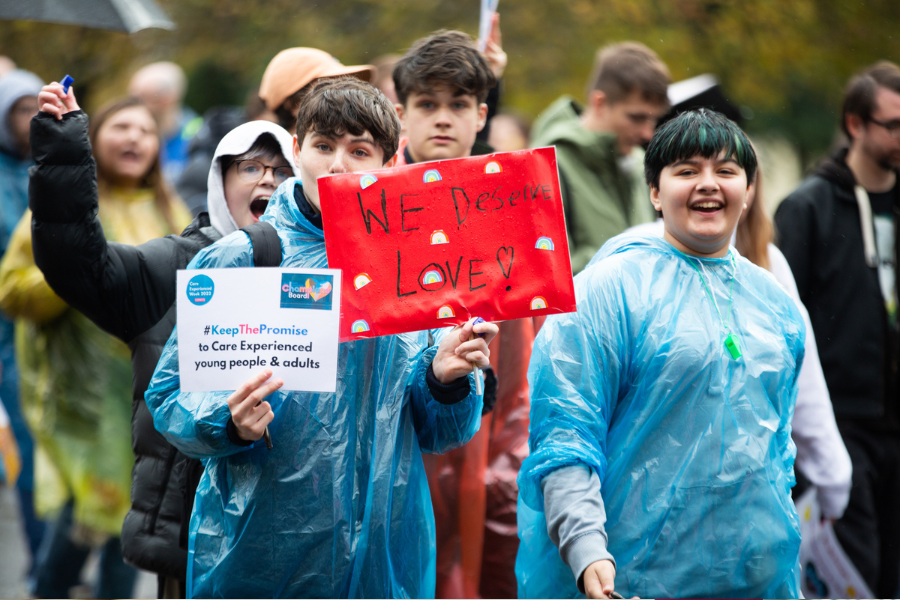
Introduce the Scottish Human Rights Bill which includes Care Experienced people within the Equality section.
Who Cares? Scotland welcomes the commitment in the Programme for Government to develop a Human Rights Bill in the second year of this Parliament. While we had hoped this would be introduced in the first year, this is an important opportunity to strengthen human rights protections in Scotland to ensure that everyone can enjoy their rights, regardless of their circumstances or background. For Care Experienced people, that opportunity is particularly significant.
The 2020 Independent Care Review found that Care Experienced people are almost twice as likely to have poor health, over 1.5x more likely to have financial difficulties and over 1.5x more likely to experience severe multiple disadvantage (homelessness, substance use, mental health issues). Six years on, these inequalities persist.
Our Lifelong Rights Campaign calls for these inequalities to be recognised and addressed as a human rights issue. Through our Summer of Participation in 2023, more than 80% of Care Experienced adults who took part told us they wanted additional protection for their rights in law.
We believe the law must recognise Care Experienced people as a group of rights holders who face barriers to enjoying their rights across their lifetime. It would also provide a clearer legal route to challenge discrimination and hold public bodies to account when Care Experience creates barriers to accessing rights.
Children and young people must grow up loved, supported and able to enjoy their rights and, when they grow into adults, this must continue. This is the opportunity to make lifelong rights a lasting part of Scotland’s human rights framework.
The next step must be to ensure that Care Experienced people are explicitly recognised and named within the Equality section of this legislation.
Areas for more focus
At our Summer Festival in 2025, our Care Experienced members voted for mental wellbeing and education as their top priorities for politicians.
Our 2022 mental health report ‘Tend Our Light’ found that 100% of participants felt that their care experience had negatively impacted their mental health and 70% had been unable to access mental health support. Two years later, the impact of care experience on loneliness was also highlighted by participants who informed our 2024 Belonging and Connection issue paper. 75% of respondents reported struggling with loneliness, and around half felt that their time in care had negatively impacted on their sense of belonging and connection.
Additionally, the educational experiences for Care Experienced people follow a similar pattern. For Care Experienced people, receiving a good education can be a route to overcome socioeconomic barriers and enable them to pursue their goals and aspirations. Yet, the most recent statistics show that educational outcomes for Care Experienced children continue to be much lower than average including on attendance, school leaving age and SCQF level 5 attainment.
We need a more proactive and concerted effort across schools and communities to change these outcomes and experiences. This means ensuring professionals understand care experience and trauma, providing proactive and lifelong mental health support and helping Care Experienced people maintain and build the loving relationships and support networks they need to thrive.
A lack of understanding of care experience across school communities remains a significant barrier. This was identified as a key issue in our 2025 Education report and further evidenced by the experiences of young people who spoke during last year’s evidence session. Care Experience is not currently included in the curriculum and understanding of care experience and of the specific barriers faced by Care Experienced pupils varies widely between schools.
Our ‘Communities that Care’ Whole School Approach involves educating entire school communities on care experience with the aim of upholding children’s rights and creating more empathic and inclusive communities. Successfully delivered in Renfrewshire and currently being implemented in Clackmannanshire and Edinburgh, it creates the conditions for Care Experienced children and young people to be nurtured and supported in their schools and wider community.
We urge the Scottish Government to commit to the national roll-out of the Communities that Care Whole School Approach across Scotland, ensuring every school has the knowledge and culture to support Care Experienced children and young people to achieve their aspirations.
What’s next?
While we welcome the commitments made in the Programme for Government, we urge the Scottish Government to be bolder and braver in keeping the Promise to Care Experienced people. We want to see MSPs from every party work together across the chamber to ensure that policy and public investment deliver real change for those who need it most.
We can and will create a lifetime of equality, respect and love for all Care Experienced people in Scotland.